
You would think claiming Australian citizenship through your mum or dad would be straightforward. You were born overseas, your parent is Australian, you fill in a form and you are done. Right?
Not quite. Citizenship by descent is one of the most misunderstood pathways in Australian migration law, and the mistakes people make are surprisingly consistent. They confuse descent with conferral, miss the critical 1986 legislative cut-off, or lodge incomplete applications that sit in a queue for months before being returned. If you are considering this pathway, getting advice from an experienced Australian citizenship lawyer before you lodge can save you significant time, stress and money.
This guide breaks down the full citizenship by descent process as it stands in 2026, including the documentation pathway, the updated fee, and the common traps we see in our Melbourne practice.
First Things First: Descent vs Conferral
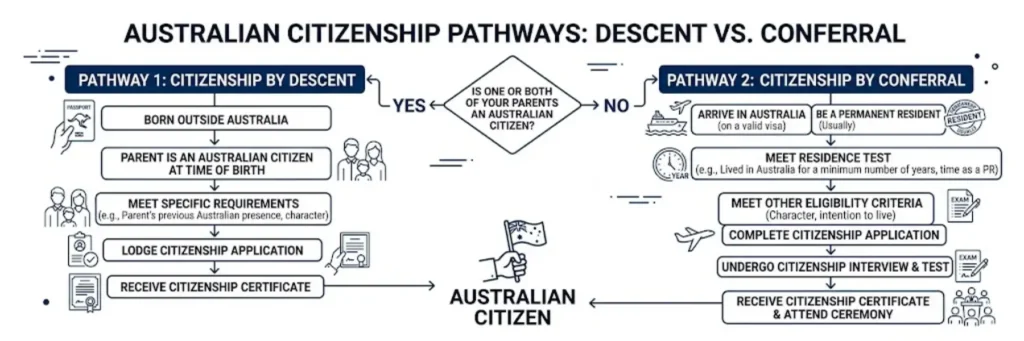
These two pathways are fundamentally different, and mixing them up is the single most common mistake we see.
- Citizenship by descent is for people born outside Australia who have at least one parent who was an Australian citizen at the time of their birth. You do not need to have ever lived in Australia, and there is no residence requirement or citizenship test. You apply using Form 118 through ImmiAccount.
- Citizenship by conferral is for people who have migrated to Australia, hold permanent residency, and meet the residence and character requirements. This pathway involves a citizenship test and a ceremony. You apply using Form 1300t.
If you were born overseas to an Australian parent, descent is almost certainly your pathway. But the eligibility rules depend entirely on when you were born, and that is where things get complicated.
The 20 August 1986 Cut-Off: Why Your Birth Date Changes Everything
The Australian Citizenship Act 1948 was replaced by the Australian Citizenship Act 2007, but the rules about descent have their roots in legislative changes that took effect on 20 August 1986. This date is the single most important factor in a citizenship by descent application.
Born before 20 August 1986:
- If your father was an Australian citizen at the time of your birth, citizenship was transmitted automatically. (Before 1983, only the father’s citizenship counted for children born in wedlock.)
- From 1975, if your mother was an Australian citizen at the time of your birth, citizenship was also transmitted.
- In most cases, you may already be an Australian citizen by operation of law. You may simply need to apply for evidence of citizenship (Form 119) rather than citizenship by descent itself.
Born on or after 20 August 1986:
- Your Australian parent must have been an Australian citizen at the time of your birth, and
- If that parent acquired their own citizenship by descent (meaning they were also born overseas to an Australian parent), they must demonstrate that they spent at least two years lawfully present in Australia at any time before your birth.
- This two-year requirement catches many people off guard. If your parent was born overseas and never lived in Australia, you may not be eligible through descent alone.
If you are unsure which rules apply to your situation, this is exactly the kind of question an Australian citizenship lawyer can resolve quickly. Our team regularly assists clients in Melbourne and across Australia with complex generational citizenship claims.
What Documents Do You Actually Need?
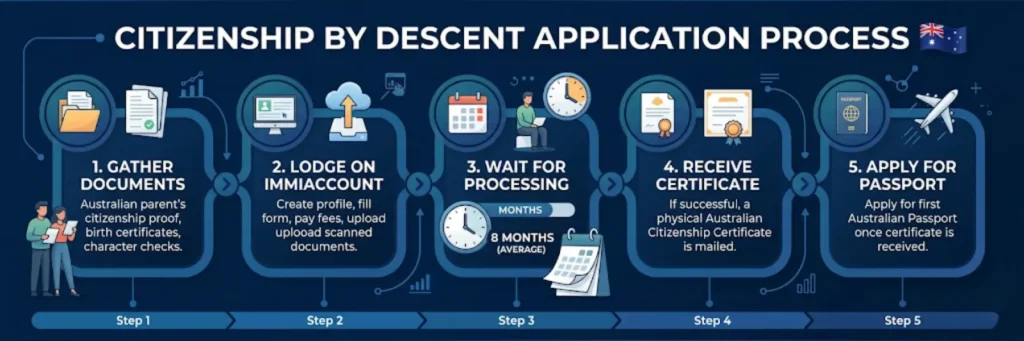
The documentation requirements for citizenship by descent are specific, and missing even one item can cause delays or a request for further information. Here is what you should be preparing:
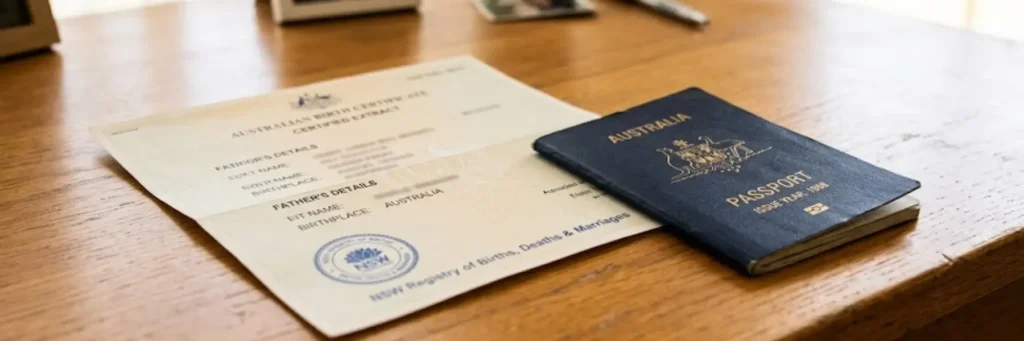
- Your full birth certificate (not an extract) showing both parents’ names
- Your parent’s proof of Australian citizenship at the time of your birth. This could be their Australian birth certificate, citizenship certificate, or registration of citizenship.
- Your parent’s Australian passport or travel records if you were born on or after 20 August 1986 and your parent acquired citizenship by descent. The Department uses these to verify the two-year lawful presence requirement.
- Name-change documents if your name or your parent’s name has changed since the birth certificate was issued (marriage certificates, deed polls, court orders)
- Police clearance certificates if you are aged 16 or over. You will generally need clearances from every country you have lived in for 12 months or more over the past 10 years.
- Character declarations addressing any criminal history, military service, or immigration issues
- Two passport-style photographs meeting current specifications
- Identity documents such as your current passport and a second form of photo ID
In some cases, the Department may also request a DNA test if the parent-child relationship cannot be established through documentary evidence alone. This is more common than people expect, particularly in cases involving older records or where the birth certificate does not clearly identify the Australian parent.
The 2026 Fee Update
From 1 July 2026, the application fee for citizenship by descent (Form 118) increased to AUD $380, up from $370 in the 2025-26 financial year (Fragomen, July 2026). For a second and each subsequent sibling applying at the same time, the fee is $160.
You pay the fee electronically through ImmiAccount when you submit your application. The fee is non-refundable, even if your application is unsuccessful, so it pays to make sure your application is complete and correct before you lodge.
How Long Does It Take?
According to the Department of Home Affairs, 90% of citizenship by descent applications are currently processed within 7 months. The actual timeframe depends on several factors:
- How complete your application is at the time of lodgement
- How quickly you respond to any requests for additional information
- Whether the Department needs to verify your parent’s citizenship or travel history
- Whether identity or character issues arise during processing
The single best thing you can do to speed up your application is to lodge it with every required document attached from the outset. Our citizenship lawyers at Amity Lawyers conduct a full pre-lodgement review of every application before it goes in, specifically to avoid the back-and-forth that causes delays.
Common Traps We See in Our Practice
After handling hundreds of citizenship matters from our Melbourne office, certain patterns come up again and again:
- Assuming your parent being “Australian” is enough. The Department needs formal proof of citizenship at the time of your birth. If your parent was a permanent resident but had not yet taken out citizenship, you are not eligible by descent.
- Not realising the two-year presence requirement applies. If your Australian parent was themselves born overseas and acquired citizenship by descent, they must show two years of lawful presence in Australia before your birth. Without this, the application will be refused.
- Submitting birth certificate extracts instead of full certificates. The Department requires full birth certificates showing both parents. Short-form extracts are not accepted.
- Overlooking police clearances. If you are 16 or older and have lived in multiple countries, you need police clearances from each country where you resided for 12 or more months in the past decade. Some countries take weeks or months to issue these, so start early.
- Confusing citizenship by descent with passport eligibility. Citizenship by descent gives you a citizenship certificate. A passport is a separate application processed through the Australian Passport Office, not the Department of Home Affairs. You apply for a passport after your citizenship is confirmed.
After You Receive Your Citizenship Certificate
Once your citizenship by descent is approved, the Department issues you a citizenship certificate. Unlike conferral, there is no ceremony for descent applicants. Your certificate is posted to you.
With your citizenship certificate in hand, you can:
- Apply for an Australian passport through Australia Post (if in Australia) or your nearest Australian embassy or consulate (if overseas)
- Enter Australia on your Australian passport without a visa
- Access consular assistance from Australian embassies worldwide
- Enrol to vote in Australian elections (compulsory for citizens resident in Australia)
- Potentially sponsor family members for Australian visas in the future
If you are already in Australia on another visa and your citizenship is approved, it is worth discussing your visa status with your lawyer. The citizenship grant may affect your existing visa conditions.
When to Get Legal Help
Not every citizenship by descent application needs a lawyer. If your parent was born in Australia, you were born after 1986, and you have clean identity documents and no character issues, the application can be relatively straightforward.
But if any of the following apply, it is worth getting professional advice before you lodge:
- Your parent acquired citizenship by descent themselves (the “second generation” scenario)
- You have identity issues, including name discrepancies across documents
- You have a criminal history or character concerns in any country
- Your parent’s citizenship status is unclear or undocumented
- You need a DNA test to establish the parent-child relationship
- Your application has already been refused and you want to understand why
At Amity Lawyers, we handle citizenship by descent applications as part of our broader Australian citizenship practice. If you are in Melbourne or anywhere in Australia and want a pre-lodgement review before you submit, call us on 03 8658 5959 or book a consultation online.
You can also read more about our appeals and cancellation services if your application has been refused and you are considering your options.
FAQs
What is the difference between citizenship by descent and conferral? Descent is for people born overseas to an Australian citizen parent. Conferral is for migrants who hold permanent residency and meet residence requirements. Different forms, different rules, different fees.
Does the Australian parent need to have been born in Australia? No. But if they acquired citizenship by descent themselves, they must show at least two years of lawful presence in Australia before the applicant’s birth.
What documents are needed for a citizenship by descent application? Your full birth certificate, your parent’s citizenship evidence, passport or travel records (if born after 20 August 1986), name-change documents, police clearances if aged 16 or over, and character declarations.
How long does it take to process? The Department of Home Affairs reports that 90% of citizenship by descent applications are processed within 7 months. Completeness of your application is the biggest factor.
Can I apply for a passport immediately after? Yes. The citizenship certificate is the gateway document. You then apply for a passport separately through Australia Post or an Australian embassy.