
Australia’s student visa rules have changed more in the past two years than in the previous decade – and most of the advice floating around online hasn’t kept up. We still see students arriving at our Melbourne CBD office with plans built on information that was accurate in 2023 but is now completely wrong. The Subclass 500 student visa looks like a different visa from the one that existed before mid-2024, and every reform interacts with the others. A guide that covers the fee increase but ignores the onshore-switching restriction, or explains the Genuine Student test without mentioning the new English floor, leaves you with an incomplete picture.
That’s why we put this guide together. As a student visa lawyer in Melbourne, we wanted one current, plain-English resource that ties every 2026 change together – so you can plan with confidence rather than guesswork.
What Changed in 2026 and Why It Matters
Put simply, Canberra has been deliberately tightening the student visa program since mid-2024. The stated goal is to reduce net overseas migration while protecting high-value education pathways. What that actually means for you on the ground is a higher financial bar, stricter English requirements, a new processing model that prioritises some applicants over others, and a set of onshore restrictions that close off pathways students previously took for granted.
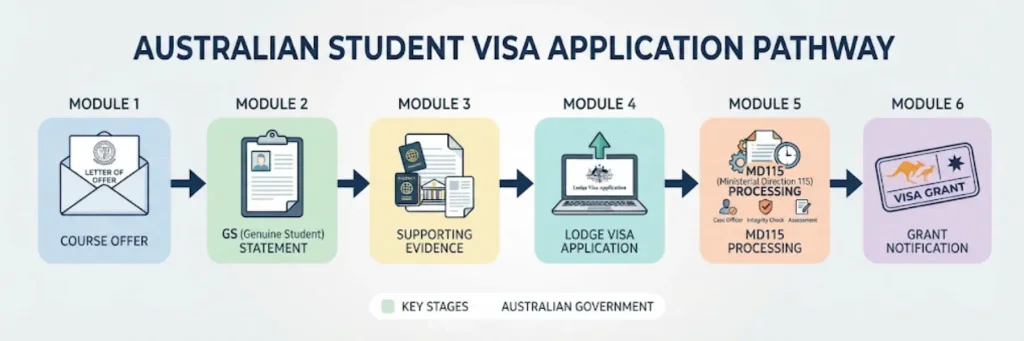
The key changes you need to understand are:
- Application fee: rose to AUD 2,500 from 1 July 2026 (up from AUD 2,000, and before that AUD 1,600)
- Genuine Student (GS) test: replaced the old Genuine Temporary Entrant test from 23 March 2024
- English language floor: IELTS 6.0 overall for most applicants (previously 5.5)
- Living-cost evidence: AUD 29,710 per year, plus additional amounts for dependants
- Work cap: 48 hours per fortnight during term, unlimited during scheduled breaks
- MD115 traffic-light model: offshore applications processed in priority order based on your provider’s enrolment status
- Onshore-switching ban: holders of Temporary Graduate (485), Visitor and Maritime Crew visas can no longer switch to a student visa while in Australia
Each of these is explained below.
The Genuine Student Test Replaces the Genuine Temporary Entrant
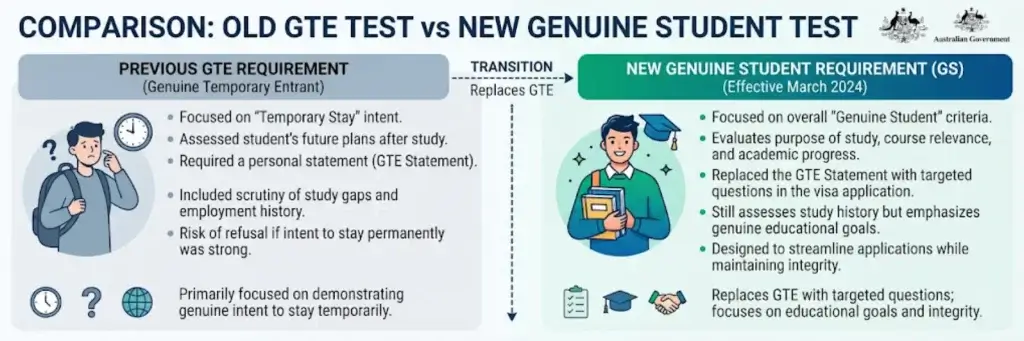
This is the change that catches the most people off guard. The old Genuine Temporary Entrant (GTE) test was replaced in March 2024 by a new Genuine Student (GS) requirement, assessed under Ministerial Direction No. 106. It boils down to one question: are you genuinely intending to study in Australia and comply with your visa conditions?
To answer that, the Department looks at:
- Your circumstances in your home country – ties, career trajectory, and reasons you cannot study locally
- Your study intentions – whether the course and institution logically fit your background
- Your immigration history – previous visas, refusals, overstays or compliance issues
- Your overall circumstances, assessed holistically
One critical difference from the old GTE test: the GS requirement expressly acknowledges that post-study pathways exist for eligible graduates. You are not penalised for having a long-term plan. But your personal statement must answer the GS factors directly. A response drafted as though the old GTE test still applies is answering the wrong question, and that mismatch is one of the most common refusal triggers we see.
Financial Evidence: The AUD 29,710 Living-Cost Benchmark
This is where a lot of applications come unstuck. You need to show genuine access to funds covering tuition, living costs, travel, and school costs for any school-age dependants. The living-cost benchmark for a single student is AUD 29,710 per year. Including a partner? Add AUD 10,394. Each dependent child adds another AUD 4,449.
Acceptable evidence typically includes:
- Personal bank statements showing funds held for a sustained period (not a one-day deposit)
- Evidence of a government loan or scholarship
- A financial declaration from a sponsor, supported by their own financial documents
The Department looks at the source, duration and accessibility of funds. A lump sum deposited the day before lodgement raises questions. Funds held steadily over three to six months are far more persuasive.
English Requirements at IELTS 6.0
Here’s one that trips up more students than you’d expect. The minimum English score for a standard Subclass 500 student visa is now IELTS 6.0 overall, with no individual band below 5.5. The equivalent PTE Academic score is 50. For ELICOS (English language preparation) courses packaged with a degree, the minimum is 5.0.
An important distinction: this is the Department’s visa floor, not your university’s entry requirement. Most Group of Eight universities require IELTS 6.5 or higher for undergraduate admission. Check both thresholds – meeting one does not guarantee you meet the other.
If you are planning to apply for a Temporary Graduate visa (subclass 485) after your studies, note that the 485 English requirement is IELTS 6.5 overall (minimum 5.5 per band), and test results must be less than 12 months old at the time of application. Planning ahead matters.
Work Rights: 48 Hours per Fortnight
Most students know there’s a work cap, but the details matter more than the headline. Condition 8105 permits you to work up to 48 hours per fortnight while your course is in session, with unlimited hours during scheduled course breaks.
Three exceptions are worth knowing about:
- Postgraduate research students (Masters by research or PhD) may work unlimited hours once their course commences
- Dependants of postgraduate research students also have no work-hour limitation
- Secondary visa holders (your partner or dependant) are limited to 48 hours per fortnight at all times, including during your course breaks – a stricter limit than the one applying to you
Breaching condition 8105 is one of the most common triggers for a Notice of Intention to Consider Cancellation. An extra shift in a busy week can put your entire visa at risk.
The MD115 Traffic-Light Processing Model
This one is newer and less well understood. Ministerial Direction 115, effective from 14 November 2025, introduced a three-tier priority system for offshore student visa applications. It replaced the earlier MD111 and ties your processing speed directly to your education provider’s enrolment numbers against their National Planning Level (NPL) allocation.
Think of it as a traffic light for visa processing:
- Green zone (Priority 1): your provider is below 80% of their allocation – fastest processing, typically one to four weeks
- Amber zone (Priority 2): your provider is between 80% and 115% of allocation – standard processing, moderate wait times
- Red zone (Priority 3): your provider has exceeded 115% of allocation – significantly slower processing
This means two students with identical qualifications lodging on the same day can have very different wait times depending on which institution they enrolled with. Before paying a deposit, it is worth checking where your provider sits. Government-sponsored students, those from Pacific Island nations and Timor-Leste, and postgraduate research students receive priority processing regardless of zone.
MD115 applies only to offshore applications. Onshore applications follow a different processing order.
The Onshore-Switching Restriction
We cannot overstate how important this one is. From 1 July 2024, holders of a Temporary Graduate visa (subclass 485), Visitor visa, or Maritime Crew visa who are in Australia cannot apply for a student visa onshore. Full stop.
So if you hold a 485 graduate visa and want to return to study, you need to leave Australia and apply from offshore. We regularly meet graduates whose entire pathway plan assumed they could simply lodge a new student visa application while still here – and that plan no longer works. Sort this out well before your current visa expires, not after.
Common Refusal Traps and How to Avoid Them
After handling hundreds of student visa matters at our Melbourne CBD office, we see the same mistakes come up again and again:
- Generic Genuine Student statements that read like templates rather than addressing the applicant’s specific circumstances and the GS factors in Ministerial Direction 106
- Inconsistency between stated intentions and course choice – for example, a qualified accountant enrolling in a Certificate IV in commercial cookery without a clear explanation
- Insufficient or unconvincing financial evidence – bank statements that do not clearly cover tuition and living costs, or funds that appeared suddenly
- Unaddressed immigration history – previous refusals, overstays, or condition breaches not explained in the application
- Gaps in education or employment not accounted for in the personal statement
A refusal is not just a lost application fee. It becomes part of your immigration history and is assessed in every future visa application you make. Getting it right the first time is significantly cheaper than trying to fix it afterwards.
How a Melbourne Student Visa Lawyer Helps
There was a time when student visa applications were largely administrative. That era is over. The Genuine Student response is a legal document assessed against legislative criteria, not a personal essay. Condition compliance, financial evidence and English requirements each carry real legal consequences when they go wrong.
A registered immigration lawyer can:
- Draft your Genuine Student response to directly address the factors in Ministerial Direction 106
- Review your financial evidence for sufficiency and credibility before lodgement
- Advise on visa conditions – particularly the work cap – so you avoid inadvertent breaches
- Act immediately if you receive a Notice of Intention to Consider Cancellation, where strict time limits apply
- Plan your pathway from study to the 485 graduate visa and beyond
Amity Lawyers is a registered Victorian law firm based at Level 24, 570 Bourke Street, Melbourne CBD. We act for students at Melbourne’s universities and CRICOS-registered vocational providers, and we offer fixed-fee packages for student and graduate visa matters. If you need to create an ImmiAccount to begin your application, our step-by-step guide walks you through the process.
Frequently Asked Questions
How much does a Subclass 500 student visa cost in 2026?
The standard application fee is AUD 2,500 from 1 July 2026. ELICOS and non-award sector students pay a reduced fee of AUD 2,050. The fee is non-refundable regardless of the outcome. (Source: IDP Australia, July 2026)
What IELTS score do I need for a student visa?
IELTS 6.0 overall with no band below 5.5 for most applicants. For ELICOS packaged courses, the minimum is 5.0. Your university may require a higher score for admission.
Can I switch from a graduate visa to a student visa while in Australia?
No. From 1 July 2024, holders of a subclass 485, Visitor, or Maritime Crew visa cannot apply for a student visa onshore. You must leave Australia and apply from offshore.
What is the Genuine Student test?
It replaced the old Genuine Temporary Entrant test in March 2024. It assesses whether you genuinely intend to study in Australia, applying the factors in Ministerial Direction No. 106. It considers your home country circumstances, study intentions, immigration history and overall situation.
How much money do I need to show for living costs?
AUD 29,710 per year for a single student, plus AUD 10,394 for a partner and AUD 4,449 per dependent child. Funds should be genuinely accessible and held for a sustained period.
Tips for a Stronger Application
- Start early. Gather financial evidence at least three to six months before you plan to lodge.
- Be specific. Your Genuine Student statement should explain why this course, at this institution, at this time – not read like a generic letter of motivation.
- Check your provider’s MD115 zone. Processing speed depends on your institution’s enrolment status, not just your own merits.
- Plan for the 485. If post-study work rights are part of your long-term plan, confirm you will meet the 485 English requirement (IELTS 6.5) and the age limit (35) before you enrol, not after you graduate.
- Get advice before you lodge. A visa refusal follows you. The cost of professional advice is a fraction of the cost of a refused application and a delayed pathway.
Ready to Apply?
Whether you’re getting ready to lodge or you’ve just received a refusal or cancellation notice, we’re here to help. Amity Lawyers offers a free 10-minute consultation to assess where you stand – no obligation, no sales pitch.
Book a consultation or call 03 8658 5959.
Disclaimer: This article provides general information only and does not constitute legal advice. Australian immigration law changes frequently. For advice specific to your situation, consult a registered immigration lawyer. All policy facts in this article are current as at September 2026 and should be re-confirmed against the Department of Home Affairs before lodgement.