
If you have been following Canadian immigration news, you already know the landscape has changed dramatically. And if you are now researching how to move to Australia from Canada, you are far from alone. We have seen a sharp increase in enquiries from Canadian-based professionals and students at our Melbourne practice over the past six months, and the reason is simple: Canada is closing doors that Australia still has wide open.
This guide is the practical pivot piece. We will walk through what has actually happened in Canada, compare it honestly with the Australian system, and map out two realistic pathways to permanent residency in Australia. No fluff, no hype, just the information you need to make a decision.
What Just Happened in Canada
Canada’s 2026 immigration overhaul is the most restrictive policy shift the country has seen in decades. Here is what the numbers look like:
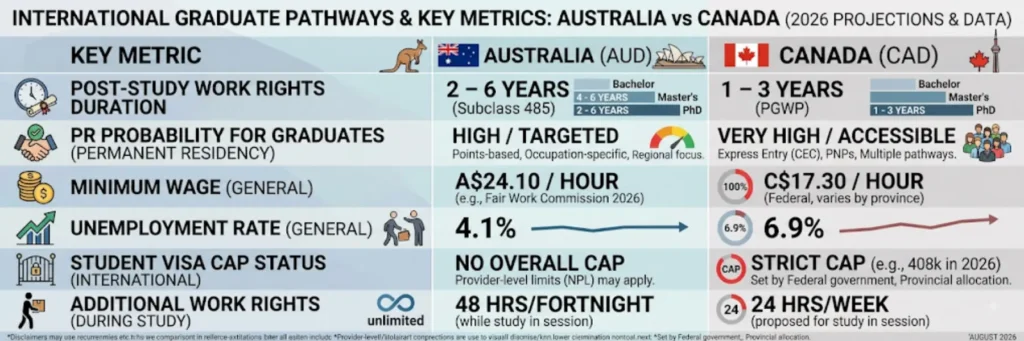
- Study permits cut by 49%. The 2026 cap is 155,000 new international student permits, down from 305,900 in 2025 (University Affairs, November 2025).
- Post-Graduation Work Permit (PGWP) restrictions tightened. Many graduates from private colleges and non-degree programs are no longer eligible.
- Temporary worker arrivals cut by 37%. The 2026-2028 Immigration Levels Plan reduces work permit arrivals alongside student numbers.
- Open work permits phased out for many spousal and dependent categories.
- Provincial Attestation Letters (PALs) now mandatory for most study permit applicants. Without one, your application is rejected before processing even begins.
The Canadian government’s stated position is clear: the era of arriving in Canada first and working out immigration later is over.
For international students and skilled workers who had been building their lives around the Canadian pathway, this creates a real problem. And for many, Australia is the logical alternative.
How Australia Compares Right Now
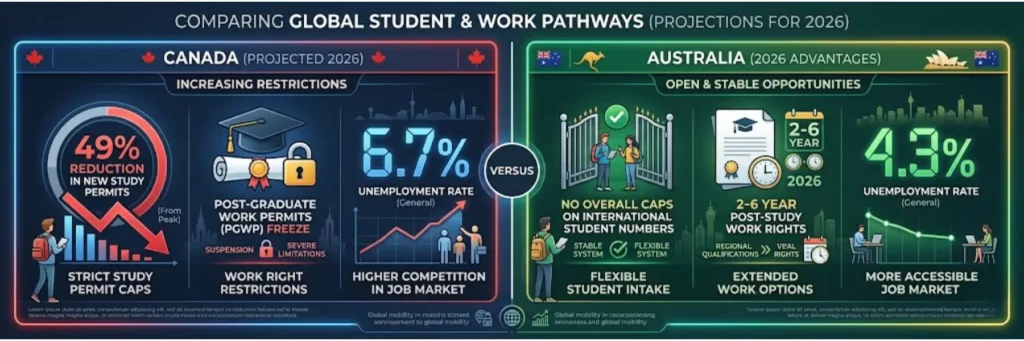
Australia is not without its own policy changes, but the overall posture toward skilled migration and international education remains significantly more welcoming. Here is a side-by-side look at the key differences:
- No hard cap on student visas. Australia does not impose a national limit on student visa approvals. While refusal rates have increased for some nationalities, there is no equivalent to Canada’s 155,000 ceiling.
- Post-study work rights of 2 to 6 years. The Temporary Graduate Visa (Subclass 485) offers 2 years for a bachelor degree, 3 years for a master’s by coursework, and up to 6 years for a PhD. Canada’s PGWP, where it remains available, typically offers 1 to 3 years.
- Lower unemployment. Australia’s unemployment rate was 4.5% in June 2026 (ABS), compared with Canada’s 6.4% in July 2026 (Statistics Canada). For graduates entering the job market, that gap matters.
- Higher minimum wage. Australia’s national minimum wage is AUD $26.44 per hour from 1 July 2026 (Fair Work Commission). Canada’s federal minimum wage is CAD $18.15 per hour from 1 April 2026. Even accounting for exchange rates, Australian workers earn more at the floor level.
- Multiple PR pathways. Australia offers permanent residency through employer sponsorship, skilled independent migration, state nomination, and regional pathways. The system is complex but the routes are open.
The trade-off is cost. Australia’s student visa application fee is AUD $2,500, significantly higher than Canada’s CAD $235. Tuition fees for master’s programs in Australia typically range from AUD $30,000 to $50,000 per year. But for applicants who are comparing total outcomes, including post-study work rights, earning potential and PR probability, Australia often comes out ahead.
Pathway 1: Study in Australia, Then Transition to PR
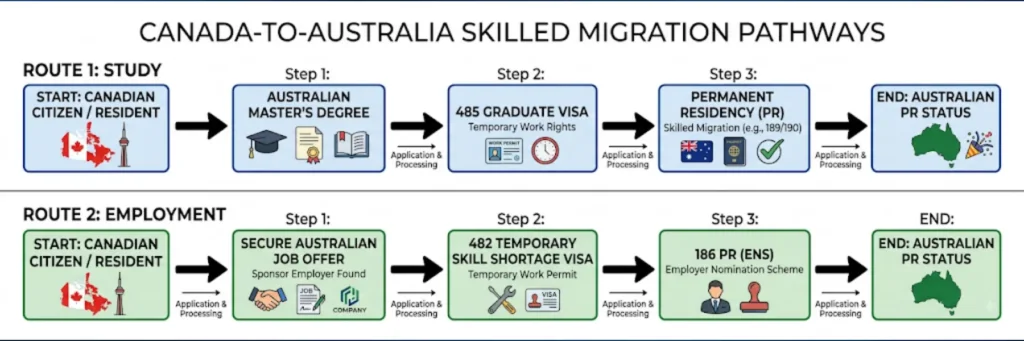
This is the most common pathway for people currently in Canada who do not yet have an Australian job offer. The typical route looks like this:
Step 1: Enrol in a CRICOS-registered master’s program
Australian universities offer master’s programs across high-demand fields including IT, engineering, healthcare, education and accounting. Your program must be registered on CRICOS (the Commonwealth Register of Institutions and Courses for Overseas Students) to qualify you for a post-study work visa.
Important: a Canadian degree does not qualify you for the Australian Subclass 485 graduate visa. You need to complete an Australian qualification. Our student visa lawyers can help you identify programs that align with your career and migration goals.
Step 2: Apply for the Temporary Graduate Visa (Subclass 485)
After completing a master’s by coursework at an Australian institution, you receive 3 years of full work rights. A master’s by research or PhD attracts even longer stays. During this time, you can work for any employer in any field, anywhere in Australia.
Step 3: Transition to permanent residency
The most common PR pathways from a 485 are:
- Subclass 189 (Skilled Independent): Points-tested, no sponsor needed. Competitive, typically requiring 85+ points.
- Subclass 190 (Skilled Nominated): State-nominated, adds 5 points to your score. Victoria actively nominates in healthcare, engineering, IT and education occupations.
- Subclass 491 (Skilled Work Regional): Regional pathway with a subsequent PR visa (Subclass 191) after 3 years.
Our skilled migration lawyers assess your points score, occupation eligibility and state nomination prospects before you commit to a study pathway.
Typical timeline: 2 years study + 12 to 18 months for PR application = approximately 3 to 4 years total.
Pathway 2: Employer Sponsorship from Canada
If you already have professional experience in a field on Australia’s occupation lists, you may be able to skip the study route entirely and secure employer sponsorship.
Step 1: Find an Australian employer willing to sponsor
Australian businesses in sectors with skills shortages, including IT, engineering, healthcare, construction, hospitality and aged care, can sponsor overseas workers through the Skills in Demand Visa (Subclass 482). The employer must be approved as a standard business sponsor and nominate a position that matches your qualifications.
Step 2: Work on the 482 visa
The Subclass 482 allows you to live and work in Australia for up to 4 years. After a qualifying period (typically 2 years in the nominated role), you become eligible to transition to permanent residency.
Step 3: Apply for the Employer Nomination Scheme (Subclass 186)
The 186 visa grants permanent residency. Your employer nominates you, and you apply under the Temporary Residence Transition stream. This is one of the most straightforward PR pathways in the Australian system.
Our employer-sponsored visa lawyers handle both the employer and employee sides of the sponsorship process, from nomination through to PR.
Typical timeline: 2 to 3 years from initial 482 grant to PR approval.
Do Canadian Qualifications Transfer?
This depends entirely on your occupation. Here is a practical overview:
- IT and software engineering: Canadian degrees and experience are well recognised. The Australian Computer Society (ACS) assesses qualifications for migration purposes.
- Engineering: Engineers Canada qualifications are generally recognised by Engineers Australia, though you may need to provide a Competency Demonstration Report.
- Trades: Many Canadian trade qualifications can be assessed through Trades Recognition Australia (TRA), but requirements vary by trade. Electricians, plumbers and welders are in high demand.
- Healthcare: Nurses, doctors and allied health professionals need registration with the Australian Health Practitioner Regulation Agency (AHPRA). This process can take several months and may require bridging examinations.
- Accounting and finance: CPA Canada qualifications are generally recognised, but you will likely need a skills assessment from CPA Australia or Chartered Accountants ANZ.
If you are unsure whether your qualifications will be recognised, a skills assessment review is the first step. We can advise on which assessing authority applies to your occupation and what additional documentation you may need.
Can You Apply for Both Canadian and Australian PR at the Same Time?
Yes. There is no restriction on holding parallel PR applications in both countries. Many of our clients maintain their Canadian immigration options while pursuing Australian pathways simultaneously. You can hold permanent residency in both Canada and Australia.
The Cost Comparison at a Glance
- Student visa fee: Australia AUD $2,500 vs Canada CAD $235
- Master’s tuition (per year): Australia AUD $30,000-$50,000 vs Canada CAD $20,000-$40,000
- National minimum wage: Australia AUD $26.44/hr vs Canada CAD $18.15/hr
- Post-study work rights: Australia 2-6 years vs Canada 1-3 years (where available)
- Unemployment rate (mid-2026): Australia ~4.5% vs Canada ~6.4%
Australia’s upfront costs are higher. But with longer work rights, higher wages, and stronger employment outcomes after graduation, many applicants find the return on investment is significantly better.
What You Should Do Next
If you are seriously considering making the move to Australia from Canada, here is the order of operations:
- Get a skills assessment review. Understand whether your Canadian qualifications and experience are recognised in Australia before you commit to a pathway.
- Check your points score. If you are considering the skilled migration route (189/190/491), your age, English proficiency, work experience and qualifications all contribute to a points score. We can calculate yours and tell you where you stand.
- Explore employer sponsorship. If you have professional experience in a shortage occupation, this may be the faster route.
- Do not assume your Canadian degree qualifies you for an Australian graduate visa. It does not. The 485 visa requires an Australian CRICOS qualification.
- Talk to an Australian immigration lawyer early. The system is complex, deadlines are strict, and making the wrong choice of pathway can cost you years.
At Amity Lawyers, our Melbourne-based immigration team handles student visa applications, employer-sponsored visas, and skilled migration for clients across Australia and internationally. We regularly work with clients based overseas, including in Canada, through video consultations and secure document exchange.
Call us on 03 8658 5959 or book a consultation online to start mapping your Australian pathway.
FAQs
Does my Canadian degree qualify me for an Australian graduate visa? No. The Subclass 485 Temporary Graduate Visa requires completion of a CRICOS-registered program at an Australian institution. A Canadian degree does not qualify. You would need to enrol in an Australian program or pursue employer sponsorship.
Can I apply for an Australian skilled visa while still in Canada? Yes. Subclass 189, 190 and 491 can all be applied for from offshore with a positive skills assessment and a competitive points score.
What is the fastest pathway from Canada to Australian PR? Employer sponsorship via the 482 Skills in Demand visa transitioning to 186 ENS, if you have a job offer. Alternatively, the 189 or 190 skilled migration route. Both typically take 12 to 24 months.
Do Canadian skilled trade qualifications transfer to Australia? Many do, through Trades Recognition Australia. Engineering and IT qualifications from Canadian institutions are well recognised. Healthcare professionals require AHPRA registration, which has its own assessment process.
How does the cost compare between Canada and Australia? Australia’s student visa fee is higher (AUD $2,500 vs CAD $235), but the national minimum wage is significantly higher (AUD $26.44 vs CAD $18.15) and post-study work rights are longer. Graduate employment rates in Australia are also stronger.
Can I apply for both Canadian and Australian PR simultaneously? Yes. There is no restriction on parallel applications, and you can hold permanent residency in both countries.