
A 485 visa refusal is one of the worst emails a graduate can open. You have spent years studying in Australia, paid thousands in tuition, and now the visa that was supposed to bridge you into your career has been refused. We see it more often than we should at our Melbourne CBD office, and what makes it frustrating is that most refusals come down to avoidable mistakes rather than fundamental ineligibility.
The 485 visa requirements have tightened significantly since 2024, and the stakes are now higher than ever. With the application fee sitting at AUD 5,750 from 1 July 2026 (up from AUD 2,300 at the start of the year), a refusal does not just cost you time. It costs you real money, and it becomes part of your immigration history.
This guide walks through the five most common mistakes we see in refused 485 applications, what to do after a refusal, and how to avoid ending up in that position in the first place.
Why 485 Applications Get Refused in 2026
The Temporary Graduate visa looks straightforward on paper, but the detail is where graduates get caught. The Department of Home Affairs does not have discretion to overlook a missing criterion. Either you meet the requirements at the time of lodgement or you do not.
The five mistakes below account for the overwhelming majority of 485 refusals we deal with. Every one of them is preventable.
Mistake 1: Evidence Missing at Lodgement
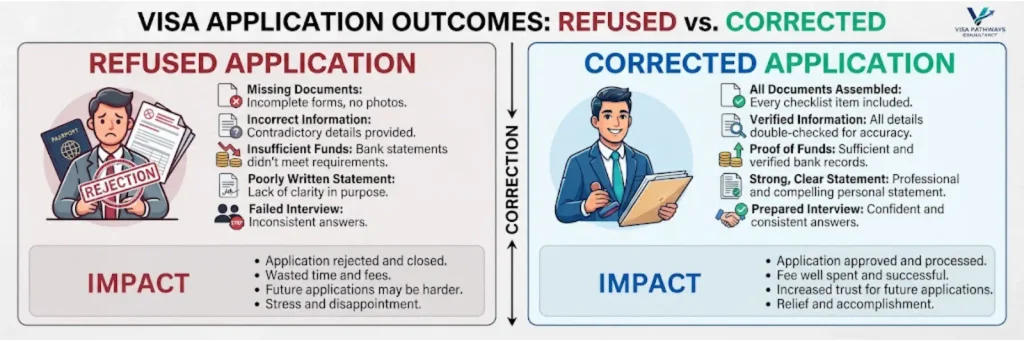
This is the most common and the most avoidable. The Department expects you to attach required evidence when you lodge your application. Unlike some other visa types, there is no routine invitation to provide documents later.
Evidence gaps that lead to refusals include:
- Completion letter not attached or an academic transcript submitted instead (they are not the same thing)
- OSHC evidence missing or showing a gap in coverage
- Qualification certificates not uploaded, or uploaded in the wrong format
- Skills assessment not included for Post-Vocational Education Work stream applicants
- Police clearances not obtained from every country where you lived for 12 or more months since turning 16
The fix is simple but requires discipline: build a checklist before you start your application, not while you are filling it in. Cross-reference every criterion against your uploaded documents before you hit submit.
Mistake 2: English Test Problems
English is where the 485 sets a trap that catches even well-prepared graduates. The rules are stricter than most people realise.
Here is what goes wrong:
- Test results older than 12 months. The 485 has a unique 12-month validity rule for English test results. Most other Australian visas accept results up to three years old. Graduates commonly reuse their student visa English score, only to discover it has expired by the time they lodge their 485. The test must have been taken within 12 months of your lodgement date.
- Wrong test format. The Department only accepts results from in-person, supervised test centres. Online or at-home versions of IELTS, PTE, or TOEFL are not accepted for visa purposes, even if the testing body considers them equivalent.
- Minimum score not met. The 485 requires IELTS 6.0 overall with no band below 5.0 (or PTE, TOEFL or Cambridge equivalent). From 2024, the minimum increased to IELTS 6.5 overall with no band below 5.5 for most applicants. Confirm the requirement that applies to your application date.
- One Skill Retake issues. IELTS now offers a One Skill Retake, and Australian universities accept it. But check whether the Department accepts the combined result for visa purposes before relying on it.
Bottom line: book your English test early, confirm it is the right format, and check the validity date against your planned lodgement date.
Mistake 3: The Six-Month Deadline
You must apply for the 485 within six months of being notified that you have completed your course. This date comes from your Completion Letter (the PRISMS notification), not from your graduation ceremony. Plenty of graduates confuse the two, and by the time they realise, the window has closed.
Key points:
- The six-month clock starts from the date on your Completion Letter
- There is no extension, no grace period and no discretion to accept a late application
- The application fee is non-refundable even if you are refused for being late
- Graduates who take a break after finishing their course are the most at risk of missing this deadline
We have seen graduates miss this deadline by a single day. The outcome is the same whether you are one day late or one month late: refusal.
Mistake 4: Choosing the Wrong Stream
The 485 has two main streams, and applying under the wrong one is a refusal ground:
- Post-Higher Education Work stream is for graduates with a Bachelor degree or higher from an Australian institution. No skills assessment is required.
- Post-Vocational Education Work stream is for graduates with a vocational qualification. It requires a positive skills assessment from the relevant assessing authority, and your qualification must relate to an occupation on the Medium and Long-term Strategic Skills List.
The most common error here is vocational graduates applying under the Post-Higher Education Work stream because it does not require a skills assessment. The Department will refuse the application. Your stream is determined by your qualification, not your preference.
For vocational graduates, the skills assessment itself is a potential trap. Assessments through bodies like VETASSESS, Engineers Australia or ACS can take two to eight months. Start the process well before your course ends, not after. A graduate who finishes their course without having begun a skills assessment may find that the six-month application window closes before the assessment comes through.
Mistake 5: Character and Health Gaps
These tend to affect a smaller number of applicants, but when they do, the consequences are serious.
- Character requirements mean you need police clearances from every country you have lived in for 12 months or more since turning 16. Missing even one clearance can hold up or derail your application.
- Health requirements may require a medical examination depending on your country of origin and intended occupation. Health assessments have a 12-month validity, so check yours has not expired before lodgement.
- Previous visa breaches such as working beyond the 48-hour fortnightly cap on your student visa, or failing to maintain enrolment, can surface during character and compliance checks.
Do not assume that a clean record means you can skip this step. Obtain your clearances early, and if you have any concerns about compliance history, get advice before you lodge.
What to Do After a Refusal: Review Options and Deadlines
The moment you receive a refusal letter, your priority is understanding the deadline. For most onshore 485 refusals, you have 21 days from the deemed notification date to apply for review at the Administrative Review Tribunal (ART). The Tribunal cannot extend this deadline for migration decisions.
Here is what you need to know:
- Read the refusal letter carefully. It will state the specific criterion you failed to meet. Your response must address that specific ground, not resubmit the same file in a thicker folder.
- Check your bridging visa status. A refusal may affect your Bridging Visa A. You may need to apply for a Bridging Visa E to remain lawful in Australia while review is pending.
- ART review fee. From 1 July 2026, the Tribunal application fee is AUD 3,727, with a 50% reduction available on financial hardship grounds. Half is refunded if the Tribunal sets aside the decision. (Source: Amity Lawyers, visa fees update July 2026)
- Reapplication vs review. Not every refusal is best challenged at the Tribunal. Sometimes a fresh application addressing the deficiency is faster, cheaper, and more likely to succeed. A lawyer can assess which route suits your circumstances.
- Do not delay. 21 days runs from when you are deemed to have been notified, not from when you opened the letter. Every day counts.
If you received your refusal while offshore, your review options are substantially more limited. Get advice immediately.
How a Lawyer Fixes a Refused 485 Application
An appeal is not a second attempt at the same application. The Tribunal has the original decision record and the reasons the case officer gave for refusal. A successful review requires evidence and submissions that directly address those reasons.
Here is what we do at Amity Lawyers:
- Identify the precise refusal ground from the decision record and work out whether it can be overcome with new evidence
- Obtain evidence that did not exist at lodgement, such as a fresh English test, a completed skills assessment, or updated police clearances
- Prepare legal submissions that address the specific legislative criterion the delegate found was not satisfied
- Represent you at the hearing, where you may give oral evidence and answer questions from the Tribunal member
- Advise honestly on prospects. Not every refusal is worth appealing, and we will tell you if a fresh application or an alternative visa pathway is the better option
As a registered Victorian law firm, we can also represent you in the Federal Circuit and Family Court if the matter goes further, something a migration agent cannot do. Learn more about how our visa appeal lawyers in Melbourne handle refusals and Tribunal matters.
Frequently Asked Questions
Can I get my 485 visa fee back after a refusal?
No. The visa application charge is non-refundable regardless of the outcome. At AUD 5,750 from July 2026, this makes it essential to get the application right the first time.
How long does a 485 Tribunal review take?
It varies by case complexity and the Tribunal’s caseload. Straightforward matters can be resolved in months, but complex cases may take longer. The Tribunal is still working through the backlog inherited from the old AAT.
Can I work while my 485 review is at the Tribunal?
It depends on your bridging visa conditions. A Bridging Visa A generally continues on the same conditions, but a Bridging Visa E may carry work restrictions that need to be separately lifted. We assess your bridging position at the first consultation.
What IELTS score do I need for a 485 visa?
IELTS 6.5 overall with no band below 5.5 for most 2026 applicants (or equivalent PTE/TOEFL/Cambridge score). Results must be from an in-person test taken within 12 months of lodgement.
Can I apply for the 485 again after a refusal?
In some cases, yes, provided you still meet all the criteria, including the six-month deadline and age limit (35 or under). A fresh application may be the better option if the refusal ground can be addressed quickly.
Tips for Avoiding a 485 Refusal
- Start your checklist early. Map every requirement against your documents at least three months before your course ends.
- Book your English test with time to spare. Factor in the 12-month validity rule and allow room for a retake if needed.
- Know your stream. Confirm whether you qualify for the Post-Higher Education Work or Post-Vocational Education Work stream before you lodge.
- Begin your skills assessment immediately if you are in the vocational stream. Do not wait until after graduation.
- Get professional advice before you lodge. A student visa lawyer in Melbourne can review your application for gaps before you submit it. The cost of a pre-lodgement review is a fraction of the cost of a refused application at AUD 5,750.
Need Help with a 485 Refusal or Application?
Whether you have just received a refusal letter or you want to make sure your application is right before you lodge, we are here to help. Amity Lawyers offers a free 10-minute consultation to assess where you stand.
Book a consultation or call 03 8658 5959.
Disclaimer: This article provides general information only and does not constitute legal advice. Australian immigration law changes frequently. For advice specific to your situation, consult a registered immigration lawyer. All policy facts are current as at September 2026 and should be re-confirmed against the Department of Home Affairs before lodgement.