
Every international graduate in Australia eventually faces the same question: what comes next? The graduate visa Australia pathway (subclass 485) gives you time. Skilled migration (189, 190, 491) gives you permanent residence. Employer sponsorship (482 to 186) gives you both, but ties you to a specific employer. The right answer depends on your degree, your age, your occupation and how much time you actually have.
We run this comparison at our Melbourne CBD office several times a week, and the answer is rarely as simple as graduates expect. This guide lays the three routes side by side so you can make an informed decision, or at least walk into a consultation knowing the right questions to ask.
How the Three Routes Work
There are three main pathways from Australian study to permanent residence. They are not sequential, meaning you do not have to complete one before starting another. But they do have different entry requirements, timelines and trade-offs, and choosing the wrong one can cost you years.
Here is the short version:
- Route 1 (485 Graduate Visa): buys you two to four years of open work rights. No points test, no employer tie. PR comes later through Route 2 or Route 3.
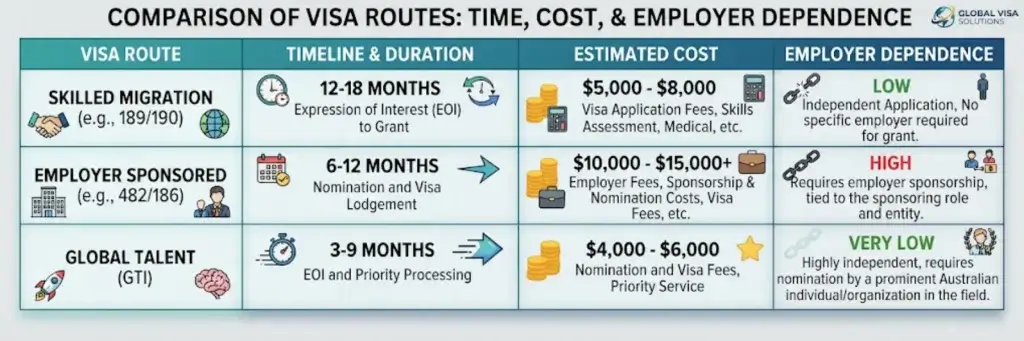
- Route 2 (Skilled Migration – 189, 190, 491): points-tested pathway to permanent residence. Requires your occupation to sit on a skilled occupation list, a positive skills assessment, and a competitive points score.
- Route 3 (Employer Sponsorship – 482 to 186): an employer sponsors you for a temporary skilled visa, then nominates you for permanent residence after two to three years of employment.
The critical point: a 485 does not stop you pursuing Route 2 or Route 3 at the same time or later. Many graduates hold a 485 while building the work experience, English score and points they need for a skilled or sponsored visa. The 485 is not a dead end; it is a bridge. But it is only useful if you use the time strategically.
The 485 Route: Work Rights First, PR Later
The Temporary Graduate visa (subclass 485) gives you full, unrestricted work rights after your studies. You can work for any employer, in any role, with no hour limit. The visa lasts two to four years for most graduates, depending on your qualification level and whether you studied in a regional area.
Key facts for 2026:
- Application fee: AUD 5,750 from 1 July 2026
- Age limit: 35 or under at time of application (exceptions for PhD graduates and certain passport holders)
- English: IELTS 6.5 overall, no band below 5.5
- Deadline: must apply within six months of your Completion Letter date
- No points test, no skills assessment (for the Post-Higher Education Work stream)
The 485 does not grant permanent residence. It grants time. What you do with that time determines whether you reach PR or not.
In 2024-25, data from the Department of Home Affairs showed that 26.5% of former Temporary Graduate visa holders who moved to another substantive visa went to a subclass 482 (employer sponsorship), 21.2% to a subclass 190 (state nominated), and 13.9% to a subclass 189 (skilled independent). (Source: Amity Lawyers, Student Visa Lawyer Melbourne page, citing Home Affairs destination data 2024-25)
In other words, employer sponsorship, not the independent skilled pathway, is the single largest destination for Australian graduates.
The Skilled Route: 189, 190, 491 and the Points Test
The points-tested pathway is the route most graduates think of first, but it is also the most competitive. You need at least 65 points to be eligible, and invitations are ranked from the top down, so reaching 65 does not mean you will be invited.
Here is how the three subclasses differ:
- Subclass 189 (Skilled Independent): permanent residence with no employer or state sponsor required. Your occupation must be on the MLTSSL. No geographic condition. 16,900 places delivered in 2024-25.
- Subclass 190 (Skilled Nominated): permanent residence with a 5-point bonus from state nomination. Broader occupation list (MLTSSL + STSOL). Must live and work in the nominating state for two years. 33,000 places in 2024-25.
- Subclass 491 (Skilled Work Regional): provisional visa with a 15-point bonus. Broadest occupation list. Must live and work in regional Australia for three years, then apply for the subclass 191 for PR. 28,069 places in 2024-25.
Your occupation list is the variable that changes the answer fastest. A software engineer on the MLTSSL has access to all three subclasses. A hospitality manager on the STSOL only has access to the 190 and 491. An occupation not on any list shuts the door entirely, and the only options are employer sponsorship or an alternative pathway.
For a full breakdown of the points test and how to maximise your score, speak with a skilled migration lawyer in Melbourne.
The Employer Route: 482 to 186
Employer sponsorship does not require a points test or a spot on the skilled occupation list (for the Specialist Skills stream). What it does require is an employer willing to sponsor you.
The typical sequence:
- Subclass 482 (Skills in Demand): your employer sponsors you for a temporary visa lasting two to four years
- Three years of employment with the sponsoring employer in the nominated occupation
- Subclass 186 (Employer Nomination Scheme): the employer nominates you for permanent residence through the Temporary Residence Transition stream
In 2024-25, the 482 granted 68,210 primary places nationally, and the 186 offered 44,000 permanent residence places. Victoria accounted for 23.3% of all 482/SID nominations. (Source: Amity Lawyers, Employer Sponsored Visa Lawyer Melbourne page, citing Home Affairs data)
The trade-off is clear: this pathway depends entirely on your employer. You need them to apply for sponsorship, nominate you, and keep you employed for three years. Change jobs and the clock resets.
For graduates who already have a job offer from a Melbourne employer willing to sponsor, this route can be the fastest path to PR. Learn more about the process from an employer sponsored visa lawyer in Melbourne.
Comparison Table: Time, Cost, Points and Employer Dependence
| Factor | 485 then skilled (189/190/491) | 485 then employer sponsored (482 to 186) | Straight to skilled (no 485) |
| Time to PR | 4-7 years (study + 485 + skilled visa processing) | 5-7 years (study + 485 + 3 years sponsored employment + 186) | 2-4 years if points are competitive at graduation |
| Points test needed | Yes (for skilled stage) | No | Yes |
| Employer needed | No | Yes, for the full qualifying period | No |
| Occupation list required | Yes (MLTSSL, STSOL or ROL) | Yes for Core Skills stream; no for Specialist Skills stream | Yes |
| Approximate cost (govt fees only) | 485 fee + skilled visa fee | 485 fee + 482 fee + 186 fee | Skilled visa fee only |
| Age risk | Points drop at 33, zero at 45 | Less sensitive to age for sponsorship | Same as 485 + skilled |
| Flexibility | High – no employer tie | Low – tied to one employer for 3 years | High |
Who Each Route Suits
There is no single best pathway. The right choice depends on where you sit across four variables:
- Your occupation list position. On the MLTSSL with high points? Skilled migration is open. On the STSOL only? Consider the 190 or 491. Not on any list? Employer sponsorship may be the only option.
- Your age. Points-tested age points peak between 25 and 32 (30 points). They drop to 15 at 33-39 and zero at 40-44. You must be under 45 at the time of invitation. A graduate who finishes study at 33 and spends three years on a 485 is 36 before they apply, and has already lost 15 points.
- Your English score. Superior English (IELTS 8.0 in each band) is worth 20 points. Proficient English (IELTS 7.0 in each band) is worth 10. For a graduate with borderline points, the difference between Proficient and Superior can be the difference between an invitation and an indefinite wait.
- Whether you have an employer. An employer sponsorship conversation in year one of your 485 is strategic. Waiting until year three is desperate.
The Trap of Starting Too Late
The most common mistake we see is graduates treating the 485 as a holiday rather than a runway. Two to three years sounds like plenty of time, but a skills assessment can take months, SkillSelect invitation rounds are unpredictable, and state nomination programs open and close without warning.
Graduates who start planning their PR pathway in the final months of their 485 often discover:
- Their age points have dropped
- Their English test has expired
- Their occupation has been removed from a state nomination list
- Their employer is not willing to sponsor at the last minute
- They no longer have time for a skills assessment before the 485 expires
The graduates who reach permanent residence most reliably are the ones who begin the assessment within the first six months of their 485, not the last six.
How a Lawyer Runs the Three-Route Check
At Amity Lawyers, the first consultation for any graduate pathway matter covers the same ground:
- Occupation list check. Which lists is your occupation on, and which subclasses does that unlock?
- Points calculation. What is your current score, and what is realistically achievable within 12 months (better English, partner points, professional year)?
- Age trajectory. Where will your age points sit when you are realistically ready to be invited?
- Employer landscape. Is sponsorship a realistic option in your occupation and location?
- Timeline mapping. Which route gets you to PR before a critical threshold (age, visa expiry, occupation list change) shuts it down?
The output is not a single recommendation. It is a ranked list of pathways with realistic timelines, so you can make the decision with full visibility.
Frequently Asked Questions
Can I apply for a skilled visa while on a 485?
Yes. The 485 gives you lawful status and work rights while you pursue a skilled migration application. Many graduates hold a 485 while lodging an Expression of Interest and waiting for an invitation.
Do I need a skills assessment for the 485?
Only for the Post-Vocational Education Work stream. The Post-Higher Education Work stream (Bachelor degree or higher) does not require one. But you will need a skills assessment later if you pursue skilled migration, so starting it during your 485 saves time.
What if my occupation is not on any skilled list?
Employer sponsorship through the 482 Specialist Skills stream does not require an occupation list, as long as the role meets the income threshold. This may be your strongest option. Alternatively, occupation lists are reviewed periodically, so an occupation not listed today may appear in a future update.
Is employer sponsorship faster than skilled migration?
It depends. The 482 is typically granted in three to six months, and PR through the 186 TRT stream comes after three years of employment. Skilled migration can be faster if your points are high and you receive an invitation quickly, but the SkillSelect wait is unpredictable.
Tips for Choosing Your Pathway
- Check your occupation list first. Everything else follows from this. Use the Skilled Occupation Lists page on the Home Affairs website and check your state’s nomination list separately.
- Calculate your points honestly. Do not claim points you cannot evidence. An overclaim leads to refusal.
- Start your skills assessment early. Whether you need it for the 485 (vocational stream) or for skilled migration later, assessments take months. Begin before your course ends.
- Talk to your employer. Sponsorship conversations are best had early, when your position is strong.
- Get a pathway assessment. A 30-minute consultation with a student visa lawyer in Melbourne can save you years of pursuing the wrong route.
Ready to Map Your Pathway?
Every graduate’s situation is different, and the right route depends on variables that change over time. Amity Lawyers offers a free 10-minute consultation to establish which pathways are realistically open to you.
Book a consultation or call 03 8658 5959.
Disclaimer: This article provides general information only and does not constitute legal advice. Australian immigration law, occupation lists and points thresholds change frequently. For advice specific to your situation, consult a registered immigration lawyer. All policy facts are current as at September 2026 and should be re-confirmed against the Department of Home Affairs before acting on them.